
LOCAL BIOMASS INNOVATIONS WITH GLOBAL APPEAL
BLOOM BIORENEWABLES / SEPRIFY | 23.09.2026
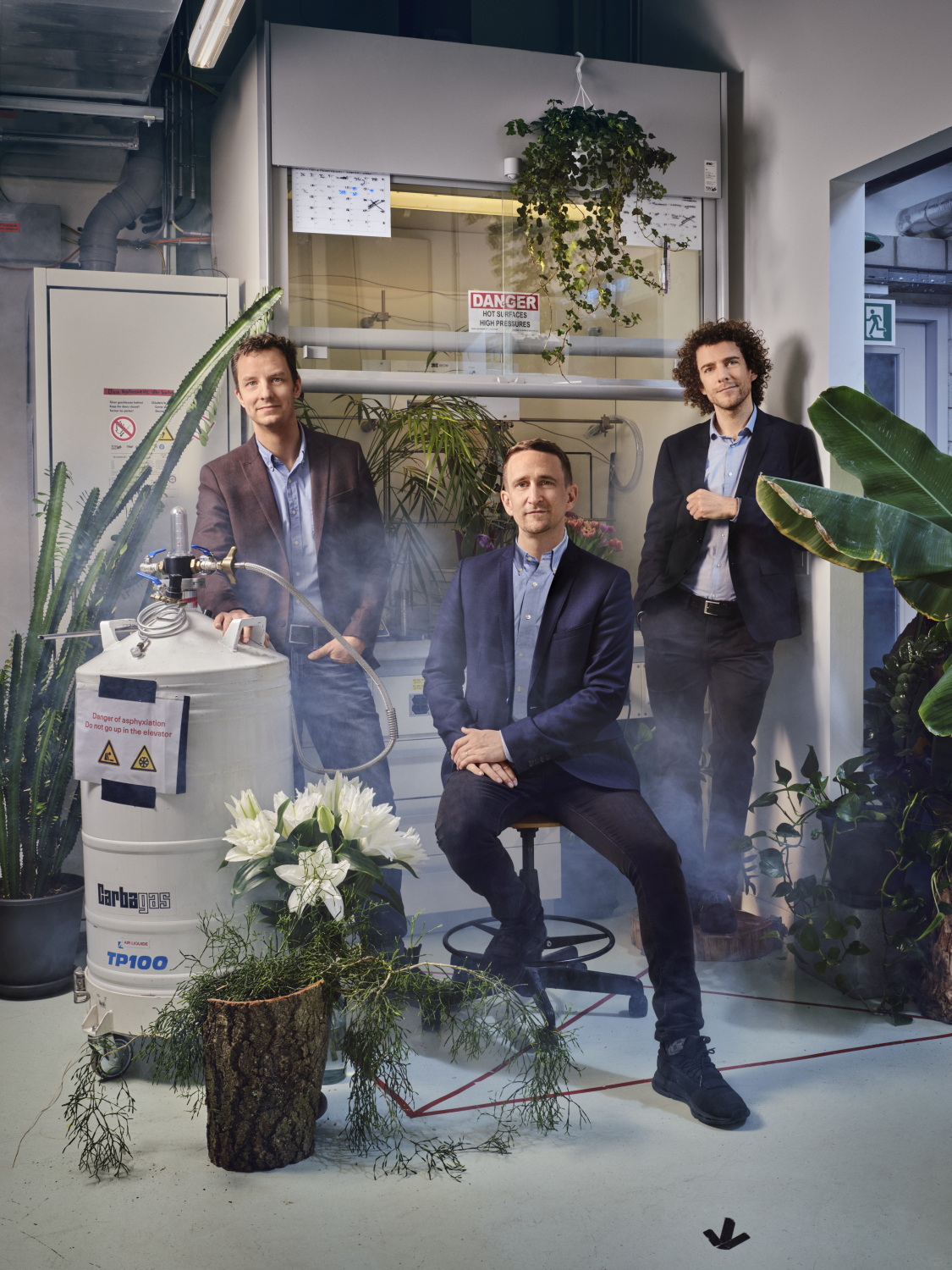
At Bloom Biorenewables, co-founders Jeremy Luterbacher, Remy Buser and Florent Héroguel (from left to right) transform plant biomass into high-value molecules.
The Fribourg bioeconomy has set itself the goal of converting biomass into a renewable alternative to fossil fuels with the aid of cutting-edge technologies. The cantonal government has also made biomass valorization a priority area of its economic development strategy, a commitment that was reaffirmed in spring 2026 when the canton hosted BIOKET, a leading international conference in this field. It was also the first time that this major event was held in Switzerland. Bloom Biorenewables and Seprify, which were ranked among the top 10 Swiss start-ups in 2025, are living proof that the canton’s strategy is already yielding results. The work of both firms shows that innovative solutions developed in Fribourg can generate international demand.
According to Remy Buser, co-founder of Bloom Biorenewables, “Sustainability, in and of itself, doesn’t move markets. The bioeconomy has to deliver on performance.” Lukas Schertel, CEO of Seprify, shares this view: “While it’s true that sustainability is now higher on the agenda of large corporations, performance and cost considerations still take precedence.”
Much more than a scientific curiosity
Bloom Biorenewables, which was founded in 2019, is working on a technology capable of utilizing all plant biomass and extracting high-value-added molecules from it. Its initial applications are primarily in cosmetics, where lignin is prized for its natural UV-blocking properties. As Florent Héroguel, co-founder of Bloom Biorenewables, points out, “The fact that we have scaled our technology from grams to metric tons proves that it is no longer a simple scientific curiosity but an industrially viable solution. The infrastructure and expertise of the ChemTech Institute played a crucial role during the scaling-up phase.”
Like Bloom, Seprify is busy turning one of its scientific innovations into an industrial solution. Its technology, which the start-up originally developed to enable the replacement of titanium dioxide with a cellulose-based white pigment, has gradually diversified into new, high-value-added applications. After raising CHF 12.25 million in early 2026, the company launched full-scale production of its cellulose-based ingredients and signed several international partnerships, most notably with Oterra and the Grolman Group. “We know where our technology can create value. The next step is to convince major corporations that we are a reliable partner, because change always represents a risk for them,” Lukas Schertel, CEO of Seprify, explains.
The fundraising, industrial scaling, and international partnerships at Bloom Biorenewables and Seprify demonstrate Fribourg’s ability to transform scientific advances into high-impact innovations. The trajectories of both firms show that the bioeconomy has what it takes to drive innovation and competitiveness.