
LIFE-CHANGING RESEARCH
BEWE LAB / UNIFR | 23.09.2026
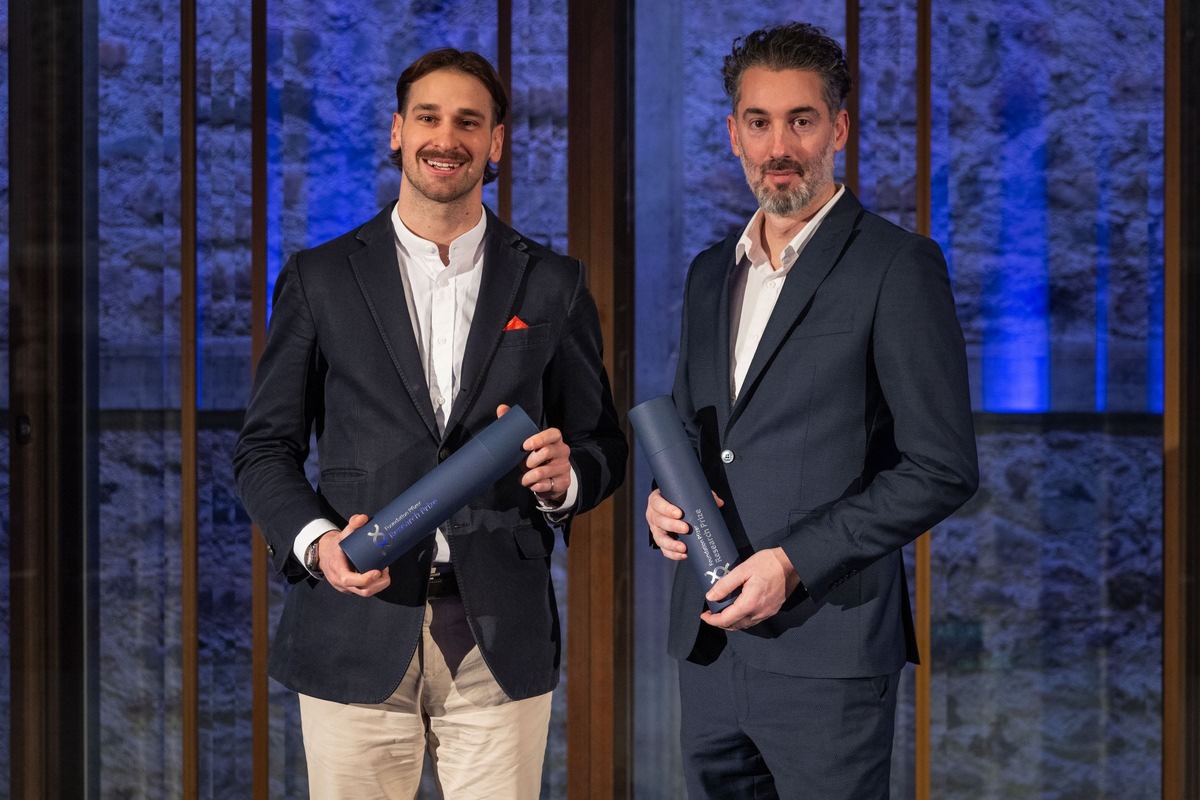
From neuroscience research to digital therapy: with Bewe Lab, Frédérik Plourde and Lucas Spierer won the 2026 Pfizer Research Prize.
Publishing scientific articles is not the only thing that researchers at the University of Fribourg (Unifr) are involved in. With the support of the Knowledge and Technology Transfer (KTT) service, a growing number of scientists are also going down the entrepreneurship route. But innovation alone is not enough to start a business. “The decisive factor is the team. Successful researchers are those who are willing to go beyond their academic role: understanding users, building a team, raising funds, and above all, making decisions in the face of uncertainty,” Valeria Mozzetti Rohrseitz, head of the KTT service, explains.
Bewe Lab perfectly illustrates this dynamic. The project grew out of Professor Lucas Spierer’s work in clinical neuroscience at Unifr’s Department of Medicine. To transform this research into viable patient solutions, Professor Spierer partnered with entrepreneur Frédérik Plourde, now the company’s CEO. The innovations continue to be validated within an academic setting before being brought to market. For Plourde, this is one of the company’s strengths: “Being science-led opens the door to international collaborations and funding that we wouldn’t otherwise have access to.” Today, Bewe Lab collaborates notably with Stanford University, and the company continues to expand in both Europe and the United States.
For a good cause
Bewe Lab develops digital cognitive therapies that leverage the brain’s reward circuitry to help people suffering from disordered eating change their habits in a lasting way. More than 13,500 people are already using the Bewe Lab app, and a dozen pilot projects are underway with several major players in the Swiss and European healthcare systems. The start-up is currently working on new solutions that address tobacco and alcohol addiction, as well as the creation of a “digital twin” of the brain’s reward system to facilitate the design of personalized therapies with the aid of AI. “We want to leverage this knowledge for a good cause: to help patients take back control,” Frédérik Plourde points out. The next goal for Bewe Lab, which won the 2026 Pfizer Research Prize in Digital Health, is to reach the one million app user mark by 2028.
Bewe Lab is not an isolated case. Xemperia, which won the 2024–2025 IFF Start-up Award, is preparing to launch its groundbreaking breast cancer screening blood test, which seeks to detect the disease at a very early stage, when the chances of recovery are highest. Like Seprify and other spin-offs, Xemperia proves that Fribourg’s research activities can generate high-impact innovations. “In recent years, academic entrepreneurship has become better appreciated, structured and supported,” Valeria Mozzetti Rohrseitz notes.