
FOR SCALING UP
CHEMTECH | 23.09.2026
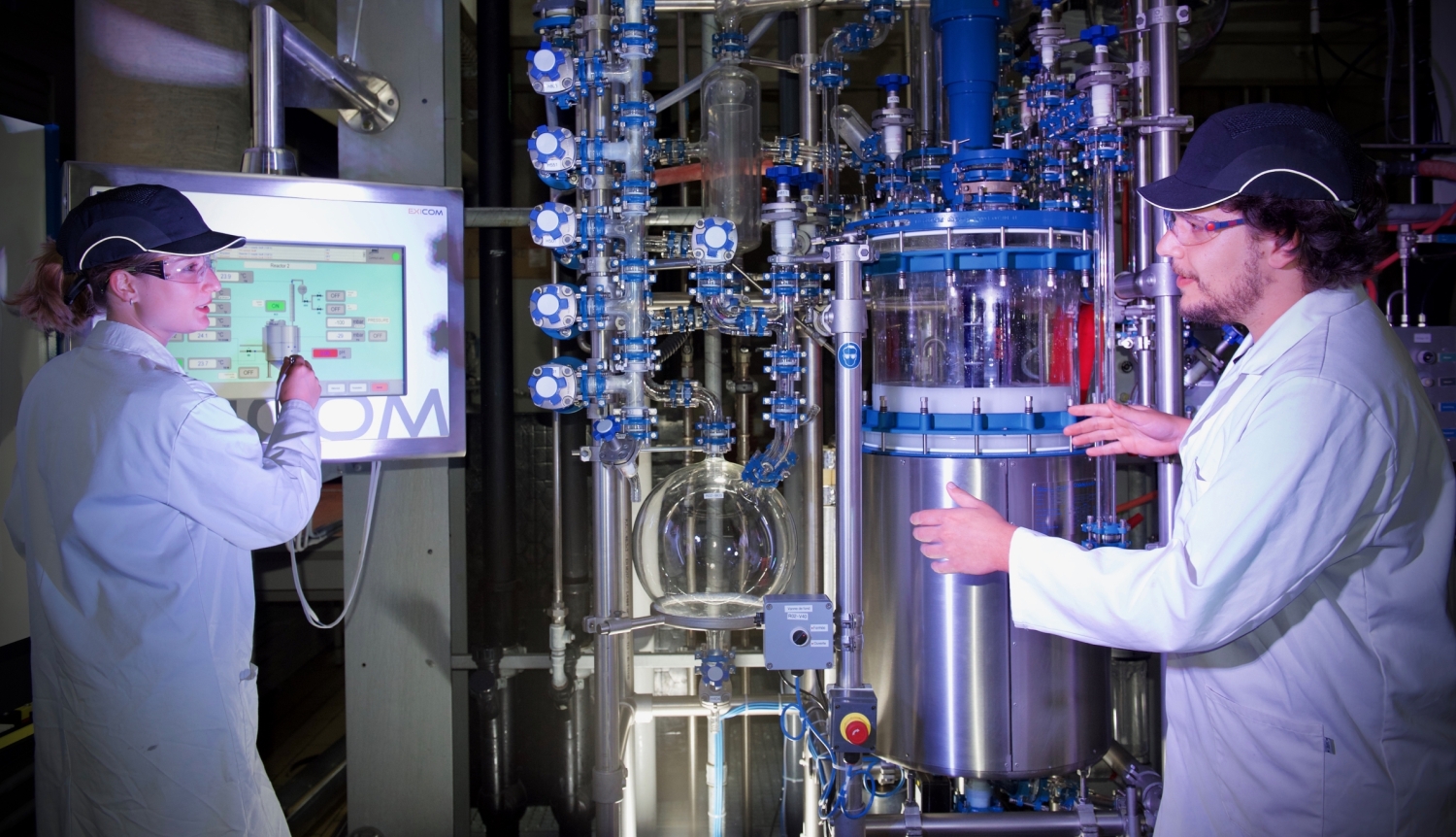
Unique in Europe, ChemTech’s pilot laboratory was expanded in 2023 to meet the rapid growth in its research activities and industry collaborations.
What do nanotechnology, polymers, digital printing, biopharmaceuticals, plastics processing, and artificial intelligence have in common? All of them, and others besides, have a dedicated institute or center of expertise in Fribourg. With most based on the Pérolles plateau or close by, they form a leading-edge ecosystem where applied research–industry collaboration is an everyday occurrence.
One of these organizations, the ChemTech Institute, plays a key role in turning innovations into industrial processes. In practice, this means helping firms navigate one of the most challenging phases of their growth: the shift from a promising laboratory discovery to reliable, reproducible, and economically viable production. “Our mission is to work closely with companies on the development of innovative products and processes,” Christophe Allemann, the Institute’s director, succinctly explains.
Founded some 15 years ago, ChemTech took an early gamble on process intensification, long before it was on the industry’s radar. This vision continues to inform the Institute’s work today, particularly on bioprocessing and green chemistry. With some 30 specialists from different but complementary backgrounds, ChemTech takes a cross-disciplinary approach that allows it to support companies of all sizes, from startups to multinationals, in sectors as diverse as pharmaceuticals, perfumery, agrifood, and advanced materials.
“Unparalleled in Europe”
This expertise is supported by pilot-scale facilities that Christophe Allemann describes as “unparalleled in Europe”: reactors with volumes of up to 630 L, distillation columns, filtration systems, and analytical equipment. ChemTech therefore has all the expertise and equipment required to develop, test, and optimize a process prior to its industrialization.
Industry collaboration with the Institute can take many forms: student projects, research contracts, Innosuisse projects, consulting, analytical services, and customized training. “By offering diverse types of support, we are able to address both ad hoc needs and assist with the development of an innovation over multiple years,” the Institute director explains.
ChemTech’s collaborations extend well beyond cantonal and national borders. In addition to local firms like Bloom Biorenewables and Seprify, the Institute works with the CHUV, dsm-firmenich, Syngenta, Metalor Technologies, Novartis, Agroscope, and the CSEM. “We even helped optimize a process for a plant in Texas, at the request of… a Norwegian company!” Christophe Allemann adds with a smile.