
“UNDERSTANDING POLLUTION TO IMPROVE AIR QUALITY”
PARTICLE VISION | 23.09.2026
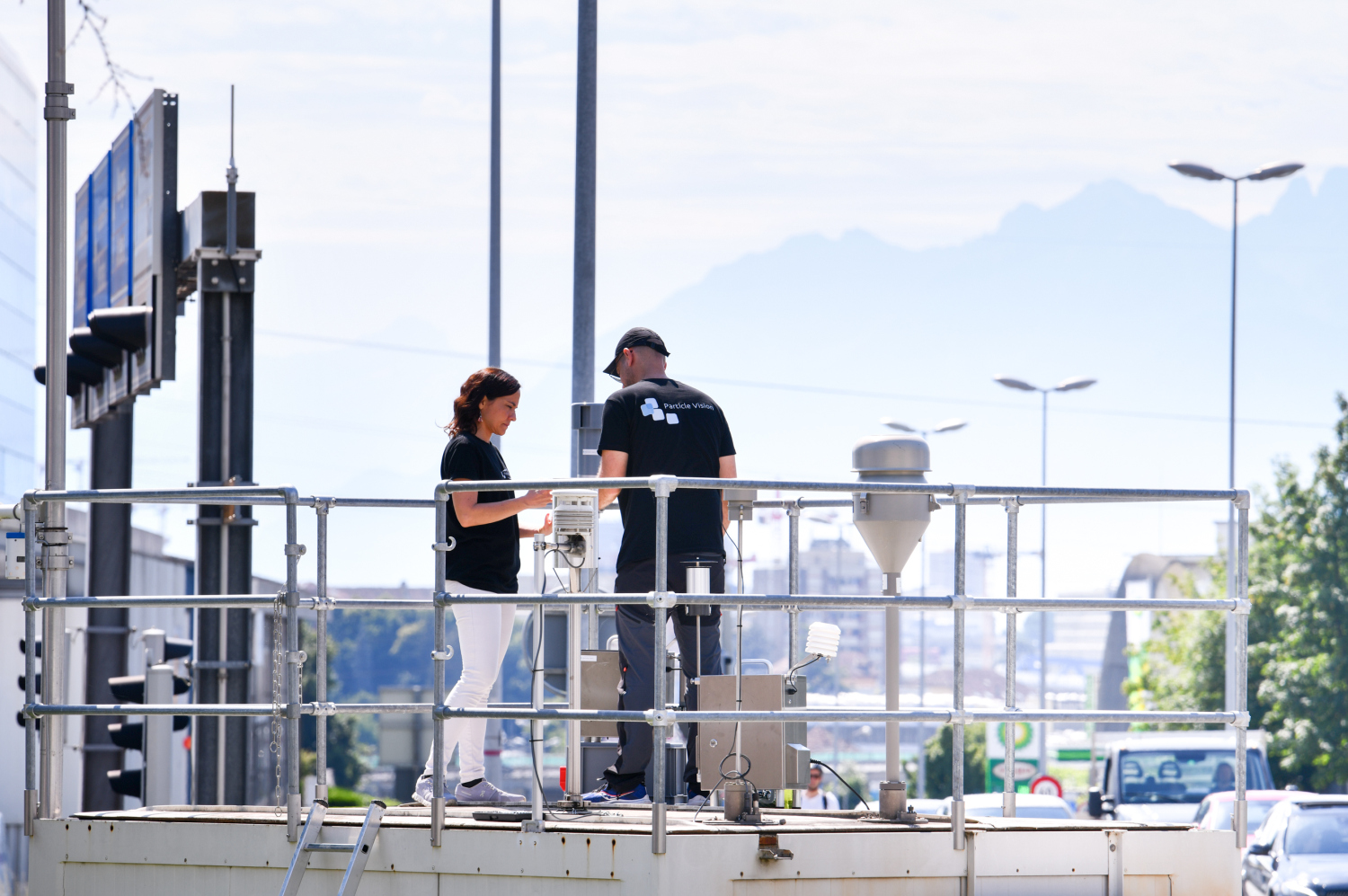
Particle Vision CEO Juanita Rausch in the field: her company’s technology can trace pollution back to its source, particle by particle.
Particle Vision has developed a technology that can detect fine particles in the air and identify their source. Juanita Rausch, director of the University of Fribourg spin-off, which was founded in 2011, looks back on the journey from research to commercialization, the challenges along the way, and how Particle Vision intends to keep its startup mindset alive even after 15 years in business.
Juanita Rausch, what does Particle Vision teach us about the air we breathe?
Particle Vision improves our understanding of the causes of air pollution. Our technology identifies and classifies fine particles like PM10 and PM2.5 (editor’s note: up to 10 and 2.5 micrometers in diameter) that are suspended in the air and, most importantly, pinpoints their sources. By analyzing their composition and origins, we can provide useful information to industry, researchers, and public agencies so that they can take more targeted action. We believe that understanding pollution is the first step toward improving air quality.
How did the idea for this technology come about?
The idea grew out of a simple question: What exactly are the particles we breathe every day, and which ones are responsible for high concentrations or levels that exceed regulatory limits? For a long time, air pollution was measured mainly by determining the amount of particulate matter present. But this does not tell us where the particles come from. We realized that by examining each particle individually and combining advanced imaging techniques, chemical composition analysis, and artificial intelligence, we could uncover information that had previously remained hidden. This became the foundation of Particle Vision.
How does your approach differ from conventional methods?
Conventional methods primarily measure the total mass of particulate matter or the overall chemical composition of a sample. It’s a bit like taking a bunch of salad ingredients and blending them into a smoothie: you know what went into the mix, but you can’t tell which ingredients are which. We examine thousands of particles individually, based on their size, shape, chemical composition, and surface properties. We then use artificial intelligence to compare their fingerprints with those of the hundreds of thousands of particles in our library, allowing us to identify their origins, such as road dust or brake or tire wear.
In which fields is your technology currently being used?
The applications are extremely varied. We help cement plants, steel companies, recycling firms, rail companies, and tire manufacturers, among others, better understand and reduce their emissions. We also collaborate with researchers, for example at PSI and Empa, as well as with institutes in Europe, the United States, and South America. Environmental agencies such as the Swiss Federal Office for the Environment also use our expertise. Our technology can be used to study industrial emissions, identify the source of unexplained dust deposits, or contribute to major international research projects. Much of our work takes place in the laboratory, but its applications are very concrete.
Particle Vision grew out of research. What changes when you turn a scientific project into a business?
Turning research into a business is exciting but tough. Developing the technology was only one of the challenges we faced. We also had to make it reliable, easy to use, and capable of solving our customers’ real-world problems. We also had to earn our customers’ trust and demonstrate the scientific validity of our approach. That is why we still publish research papers on our methodology and present our results at international conferences.
What has been the biggest challenge on this journey? And what are you most proud of?
Innovation takes time. One of our biggest challenges has been continuing to invest in research while also growing the company. On the other hand, we are particularly proud to see our technology being used in important and meaningful international projects. It is very rewarding when our work helps answer questions that previously had no answers and ultimately contributes to protecting human health and the environment.
Given that Particle Vision has been in business for 15 years, it’s no longer classified as a startup. But have you managed to keep your startup mindset alive?
Absolutely. Being a small company means that we can stay flexible, curious, and creative, react quickly, explore new ideas, and work hand in hand with our partners to develop innovative solutions. What has changed is our experience. After more than a decade, we have built up considerable expertise, forged international partnerships, and perfected a proven technology without ever losing our desire to do better and explore new opportunities.
Particle Vision is a spin-off of the University of Fribourg. What role has the Fribourg ecosystem played in your journey?
The idea for Particle Vision was born at the University of Fribourg. During the early years, the support of the Department of Geosciences was essential. Our former PhD supervisor, Professor Bernard Grobéty, believed in our vision and gave us access to the microscopy laboratory and analytical facilities. This allowed us to continue developing our technology before we were able to invest in our own equipment. Later, Fri Up and the Economic Development Agency also supported us. Fribourg offers an environment that fosters innovation, combining a strong scientific community with a collaborative entrepreneurial ecosystem. Its central location, both within Switzerland and Europe, is also an advantage for our international activities.
What are your ambitions for Particle Vision now?
We want to keep pushing the boundaries of particle analysis with the help of emerging technologies and artificial intelligence. One of our main goals is to combine the highly detailed information generated by our technology with real-time air quality data. By bringing these two sources together, we want to identify pollution episodes and their causes more quickly and accurately. The aim is not simply to generate more data, but to turn that data into actionable insights that will allow researchers, industry, and public agencies to make more informed decisions.
What advice would you give to a researcher or student considering turning an innovation into a business?
Don’t be afraid to step outside your comfort zone. A good idea is only the beginning. Innovation rarely follows a straight path, but curiosity, perseverance, passion, and collaboration can take you a long way. Stay open to learning in different fields and don’t be discouraged by setbacks. And every now and then, take a step back and ask yourself whether you are still pursuing the goals and motivations that matter most to you—both professionally and personally—or whether it is time to make some adjustments.